Why Do the Bells Toll, Mitică?
Released on Sat, September 26, 1981
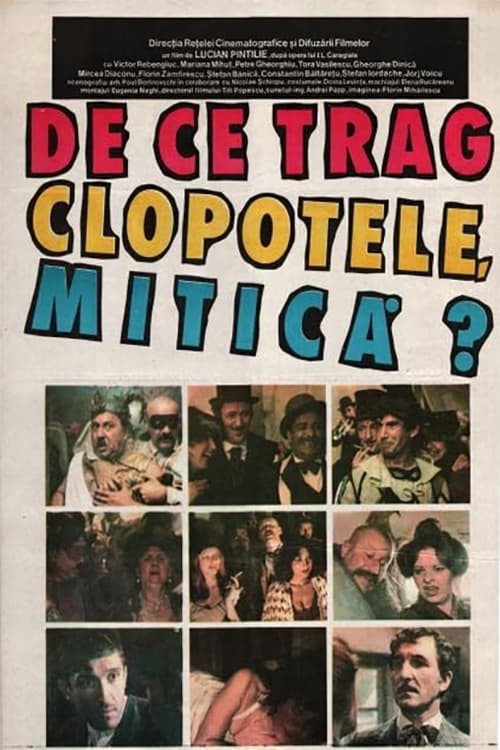
"De ce trag clopotele, Mitică?" (Why Do the Bells Toll, Mitică?), also known as "Carnival Scenes", is a film adapted from the work of Ion Luca Caragiale, a Romanian author who keenly observed and satirized the behavior of the Romanian middle class at the beginning of the 20th century. Caragiale's writing often captured a frantic and exaggerated tone, which the film successfully maintains and even amplifies.
Director Lucian Pintilie crafts a peculiar amalgamation of carnival-like situations in the movie. The overall effect presented on screen is a chaotic and comedic spectacle. The film is delivered as a boisterous and rapid-fire screwball comedy, yet simultaneously possesses a reflective and thoughtful undercurrent.
Pintilie masterfully balances the uproarious energy of a carnival with moments of quiet introspection. The film’s humor is not simply frivolous; it invites the audience to ponder the societal absurdities that Caragiale so sharply critiques.
 However, the film's sharp critique of society did not sit well with the communist regime in Romania. "De ce trag clopotele, Mitică?" was promptly banned. This censorship reflected the government's sensitivity to any art that could be interpreted as critical of the ruling power or as a destabilizing influence on the established social order.
The film remained hidden from the public for a decade. It was only after the fall of the communist dictator Nicolae Ceaușescu in 1989 that the film was finally allowed to be released and viewed by Romanian audiences.
The delayed release underscores the importance of artistic freedom and the power of cinema to reflect and challenge societal norms. "De ce trag clopotele, Mitică?" stands as a testament to both Caragiale's enduring literary genius and Pintilie's bold cinematic vision, finally unveiled to a nation ready to confront its past.




 Petre Gheorghiu
as Crăcănel